

Why Botswana Is Quietly Entering Serious HNW Conversations — And What Most Advisers Still Get Wrong
Over the past eighteen months, the nature of the conversations crossing our desk has shifted.
Lawyers, wealth advisers, and family-office principals — from London, the Gulf, India, and across Southern Africa — increasingly raise Botswana unprompted. Two years ago, they did not. The question used to be “what do you do in Botswana?” Now it is closer to “where should Botswana sit in the structure?”
That shift is worth examining honestly, because it is happening quietly — below the level of the louder citizenship-by-investment marketing — and because most of the advisers asking the question are starting from the wrong premise.
The interest is rational, not hype
Three things are drawing serious attention, and none of them is the passport.
Institutional continuity. Botswana has maintained constitutional government continuously since independence in 1966. In late 2024, it transferred executive power between parties through the ballot box, calmly and without incident — a live demonstration of institutional maturity rather than a historical claim. For a principal weighing where to anchor part of a family structure for the next thirty years, that track record matters more than any single year’s headline economic number.
Capital mobility. This is the feature most advisers underestimate, and it is the one that genuinely separates Botswana from much of the continent. Botswana abolished exchange controls in February 1999 and has not reinstated them since. A resident can hold foreign-currency accounts — US dollars, sterling, euro, rand — alongside the pula, and repatriate capital, dividends, and profits without seeking capital-control approval. Standard anti-money-laundering and bank-level compliance review applies, as it does in any reputable financial centre, but there is no exchange-control permission regime sitting on top of legitimate capital flows. The pula itself is managed through a crawling-band mechanism rather than left to float freely, which has historically given it a steadiness against the rand and other regional currencies that few of Botswana’s neighbours can match. For a family that needs capital to move cleanly in and out of an African footprint, that combination is rare.
A genuine operating footprint. Botswana is landlocked but not isolated. It sits inside SADC and SACU, with road and rail connections into South Africa, Namibia, and Zambia. For a principal whose thesis is actual African market access — not paper exposure held through an offshore vehicle pointed at the continent — being physically and legally established inside the regional bloc is a different proposition from owning a holding company on an island.
The instrument everyone is asking about
The reason Botswana is in these conversations at all, of course, is the announced Citizenship-by-Investment programme — and here precision matters, because the public reporting runs well ahead of the legal reality.
Botswana’s government announced, at the United Nations General Assembly in September 2025, its intention to launch an Impact Citizenship Programme, with an implementation agreement signed with a specialist investment-migration firm. Public guidance indicates a contribution in the region of US$75,000 to US$90,000 under a limited quota system, which would position it among the most affordable open programmes in the world.
But — and this is the part the marketing tends to skim — the programme is not yet open. Only a pre-registration portal exists. The final legislative framework, the processing and due-diligence fees, the residency conditions, and the precise contribution tiers remain subject to official confirmation. A launch has been signalled for 2026, not delivered.
More fundamentally, the programme rests on a legislative prerequisite that is still in progress. Botswana is reforming its citizenship framework to permit dual nationality — the legal foundation on which the announced Impact Citizenship Programme depends. Until that reform is enacted, the programme cannot operate as advertised. This is not a reason for scepticism; it is simply the actual state of play, and any adviser recommending the instrument to a client should be working from it.
What most advisers get wrong
If the interest is rational, the analysis often is not. Three errors recur.
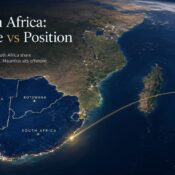
Treating it as “cheaper Mauritius.” This is the most common, and it misreads the instrument entirely. Mauritius is a structuring jurisdiction — treaty network, fund domiciliation, holding vehicles. That is what it is good at, and Botswana does not replace it. Botswana is a footprint jurisdiction: citizenship, regional operating ground, free capital movement. The two answer different questions. A principal who frames the choice as Mauritius-versus-Botswana has already made an error of category. The sophisticated structures we see use both, deliberately, for different jobs.
Treating it as a passport play. Reducing Botswana to its prospective passport ranking misses the point. The value, for most family structures, is not visa-free travel — it is the combination of an operating base, a stable currency regime, free capital flow, and a common-law foundation, with citizenship as the anchor that ties a principal to all of it. Bought purely as a travel document, it underwhelms. Understood as an operating-and-succession instrument, it makes sense.
Assuming it can be navigated from a distance. This is where international advisers most often come unstuck. A great deal of the value in Botswana sits in detail that does not travel well from London or Dubai — how banking onboarding actually works for a non-resident principal, what documentation and timing a foreign-currency account realistically requires, how property and land tenure operate for non-citizens, and the difference between the programme as announced and the programme as it will actually function once legislation is enacted. These are not questions a slide deck answers. They require local judgment.
The honest position
Botswana is not the right answer for every family. For some structures it is irrelevant; for others it is genuinely useful; and the announced citizenship programme, until its legislation is enacted and its rules published, should be discussed as a developing opportunity rather than a finished product.
But the underlying shift is real. A stable, common-law, capital-mobile jurisdiction inside the SADC bloc, actively positioning itself to attract international families and capital, is a serious proposition — and the advisers raising it with us are right to be looking, even if many of them are looking at it the wrong way.
The discipline, as with any jurisdiction, is knowing which clients it actually fits, and being honest about the parts that are still being built.
Enterprise Botswana is a private advisory practice based in Gaborone, advising principals, family offices and capital allocators on residency, citizenship, capital deployment and corporate establishment in Botswana. Legal services are provided separately by Khan & Khan Law Offices, a Botswana-registered law firm. If Botswana is a question you are weighing for a client or for your own structure, we offer a 30-minute private introductory call — no pitch, simply whether and how Botswana is relevant to what you are trying to build.



Recent Posts