


FROM THE SOUTHERN AFRICA STRATEGY OFFICE
Two businesses with the same plan can end up in completely different places — for no reason other than the order in which they did things. In a cross-border entry, sequence is not administration. It is strategy.
There is a moment, early in most Southern Africa entries, when a principal decides it is time to get started. A company is registered. A first tranche of capital is arranged. Someone is appointed on the ground. It feels like progress — motion, commitment, momentum.
It is also, very often, the sequence run backwards.
The businesses that struggle in Southern Africa rarely have a worse plan than those that succeed. What they have is a worse order. They incorporated before they had validated demand, moved capital before they understood the structure it should move into, and appointed a partner before they knew enough to choose one well. Each step, taken too early, quietly removed an option that a later, better-informed version of themselves would have wanted back.
This article is about the order of operations — and one simple principle that gets it right.
Sequence is a decision, not an afterthought
Every step in a market entry has two properties that matter: how much it teaches you, and how hard it is to undo. The reflex is to sequence by what feels like progress. The discipline is to sequence by those two properties instead.
The organising principle is straightforward: do the reversible, information-gathering steps first, and the irreversible, capital-committing steps last. Early on, you know the least and can change your mind the most cheaply — so that is when you should be learning, testing and deciding on paper. Later, once the picture is real, you commit the things that are expensive to reverse: capital, incorporation, structure, people.
Get that order right and mistakes stay cheap, because you make them while you can still change course. Get it wrong and the same mistakes become expensive, because you have already locked yourself in.
The order most businesses get backwards
Here is the sequence that feels natural, and costs the most:
Register a company first, because it feels like the "real" start. Move a first tranche of capital next, to show commitment. Appoint a local partner who was warmly introduced. And then — with the entity live, the money in and the partner engaged — begin seriously testing whether the market wants what you sell, and whether this was even the right country.
Every one of those early moves is hard to reverse, and every one was made while you knew the least. If demand turns out to be thinner than assumed, you are unwinding a company, repatriating or stranding capital, and disentangling from a partner — instead of simply revising a spreadsheet. The plan was not the problem. The order was.
The right sequence
The corrective is to invert it — to spend your cheap, reversible early moves on learning, and reserve the irreversible ones for the end.
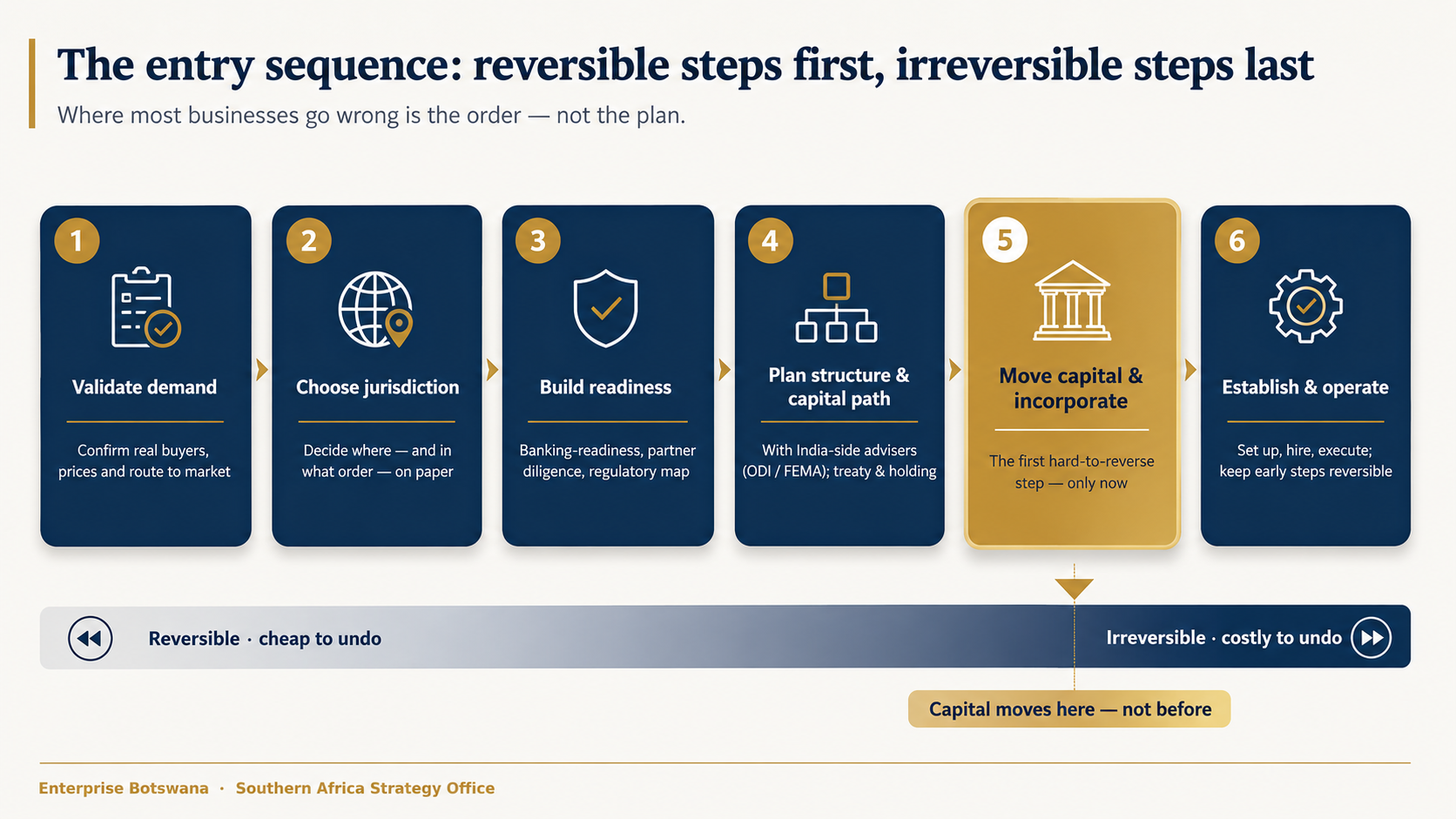
1. Validate demand. Before anything is registered or moved, confirm that real buyers exist, at prices that work, reachable through a route you can actually use. This is the cheapest step to run and the most expensive one to skip. Everything downstream inherits its honesty.
2. Choose the jurisdiction — on paper. With demand real, decide where, and in what order, using a consistent method rather than instinct. (This is the subject of our companion piece on choosing between South Africa, Botswana, Namibia and Mauritius.) At this stage the decision still lives on paper — nothing has been committed, so nothing needs unwinding if it changes.
3. Build readiness. Now prepare the ground: map the banking-readiness pathway, run genuine diligence on any prospective partner, and understand the regulatory and licensing requirements you will have to meet. Readiness is a prerequisite, not a formality — and it is still reversible. You are learning what entry will actually demand before you pay for it.
4. Plan the structure and the capital path. Decide how the operation should be held and structured, and — critically — plan how capital will move from India, with appropriately qualified India-side professionals, before any funds move. India's overseas-investment framework, administered by the RBI under FEMA, means the route, structure and reporting of outbound capital are matters to plan deliberately, not improvise. Confirm any treaty positions that bear on the structure at the time. This is the last stage that is still substantially on paper.
5. Move capital and incorporate. Only now — demand validated, jurisdiction chosen, readiness built, structure and capital path planned — do you take the first genuinely hard-to-reverse step. Because everything upstream is done, the capital moves once, into the right structure, for a validated purpose. Businesses that reach this step in the right order move deliberately. Businesses that started here move twice.
6. Establish, operate and review. Set up operations, hire, and execute — keeping the early operational commitments as reversible as you reasonably can, and reviewing against the assumptions you validated in step one. Entry is not a single event; it is a sequence that keeps its options open as long as it can.
Why the capital step sits near the end
The most consequential inversion is the capital one, so it is worth isolating what actually changes when you get it right.
Where the money lands, in what vehicle, and in what order relative to incorporation are not administrative details — they shape tax, governance and flexibility for years. Sequenced after the structure is planned, capital moves once, into the vehicle designed to hold it. Sequenced first, it often has to be moved again, restructured, or explained later at cost. That is the whole difference between moving capital once and moving it twice.
This is why the step belongs with qualified India-side professionals, and why Enterprise Botswana identifies it rather than advises on it: the FEMA, RBI and ODI dimensions are India-side regulatory matters that must be handled by those authorised to do so, before funds move. And the standard for the banking that receives it is readiness, not a guarantee — preparation that improves the odds and the timeline, never a promise of an account. Placed correctly in the sequence, the capital step is deliberate. Placed first, it is a bet made before the odds are known.
A discipline, not a rigid timeline
A word on how to hold all this. The sequence is a discipline for ordering commitments, not a strict timetable. In practice the steps inform one another and loop — what you learn validating demand may reshape the jurisdiction question, and readiness work often sends you back to refine the plan. The rule is not linearity for its own sake; it is that the irreversible commitments wait until the reversible learning is done.
The single test for every step
If the six steps are too much to hold in mind, hold one question instead. Before each move, ask: if this turns out to be wrong, how cheaply can we undo it?
Steps that are cheap to undo — validating demand, comparing jurisdictions, mapping readiness — come first, and you should linger there until the picture is real. Steps that are costly to undo — incorporating, moving capital, appointing a partner you will depend on — come last, and only once the earlier steps have earned them. Sequence the whole entry by that one test, and you will rarely find yourself dismantling something expensive that you built too soon.
None of this slows a good business down. It does the opposite: it front-loads the cheap learning so that the expensive commitments, when they come, are made once and made right. And a correct order gives you something to put in front of the family: not a hunch that it will work out, but a sequence in which every irreversible step was earned.
Frequently asked questions
What should happen first when entering Southern Africa from India?
Validate demand — confirm real buyers, workable prices and a usable route to market — before registering a company or moving any capital. It is the cheapest step to run and the most expensive one to skip.
When should we move capital out of India?
Late in the sequence — after demand is validated, the jurisdiction is chosen, readiness is built and the structure is planned. Capital movement runs through India's overseas-investment framework under FEMA/RBI and should be planned with qualified India-side professionals before funds move.
Why not just incorporate early to show commitment?
Because incorporation is hard to reverse and teaches you little. Doing it before demand and structure are settled often means unwinding or restructuring later, at cost. Commitment is better shown by moving in the right order.
Does getting the sequence right slow the entry down?
No. It front-loads cheap, reversible learning so that the expensive, irreversible commitments — capital, incorporation, partners — are made once and made correctly, rather than repeated.
Can Enterprise Botswana advise on FEMA, RBI or ODI matters?
No. We identify where these India-side regulatory matters arise and where they sit in the sequence, but the advice itself must come from appropriately qualified India-side professionals.
Enterprise Botswana is the Southern Africa Strategy Office. We help Indian business owners and families make better decisions before they commit serious capital. We are jurisdiction-neutral at the diagnostic stage — the recommendation follows your commercial circumstances.