
FROM THE SOUTHERN AFRICA STRATEGY OFFICE
A Southern Africa market entry opportunity is opening in front of you. The risk is not that the opportunity is unreal — it is that the decision which determines your outcome is made in the first ninety days, before anything has been tested, and is almost impossible to reverse.
Most Indian businesses that struggle in Southern Africa do not struggle because the market was wrong. They struggle because of a decision taken early — a country chosen on a tax rate, a company registered before demand was proven, a partner trusted on a warm introduction. By the time the problem is visible, the capital has already moved.
The good news is that these are decisions, not accidents — and decisions can be sequenced. What follows is how a principal can think about the choice, the five wrong first moves to avoid, and a simple way to judge whether you are ready to move at all.
Why the obvious first move is often wrong
Two defaults catch principals out. The first is “enter South Africa, because it is the biggest market.” Sometimes correct — but the largest economy and the best first base are not always the same country. The second is “get set up, then figure it out” — incorporating and moving capital early because it feels like progress. Both convert a flexible position into a fixed one before the facts are in.
Underneath both is a single confusion: mixing up how attractive a market is with how ready you are to enter it. A market can be attractive and your entry still be unready. Keeping those two questions apart is the whole discipline.
The four jurisdictions — and the job each is good at. Set them side by side by the job they actually do, not by which name is most familiar:
No single jurisdiction performs every function in a Southern Africa market entry. Set them side by side by the job they actually do, not by which name is most familiar:
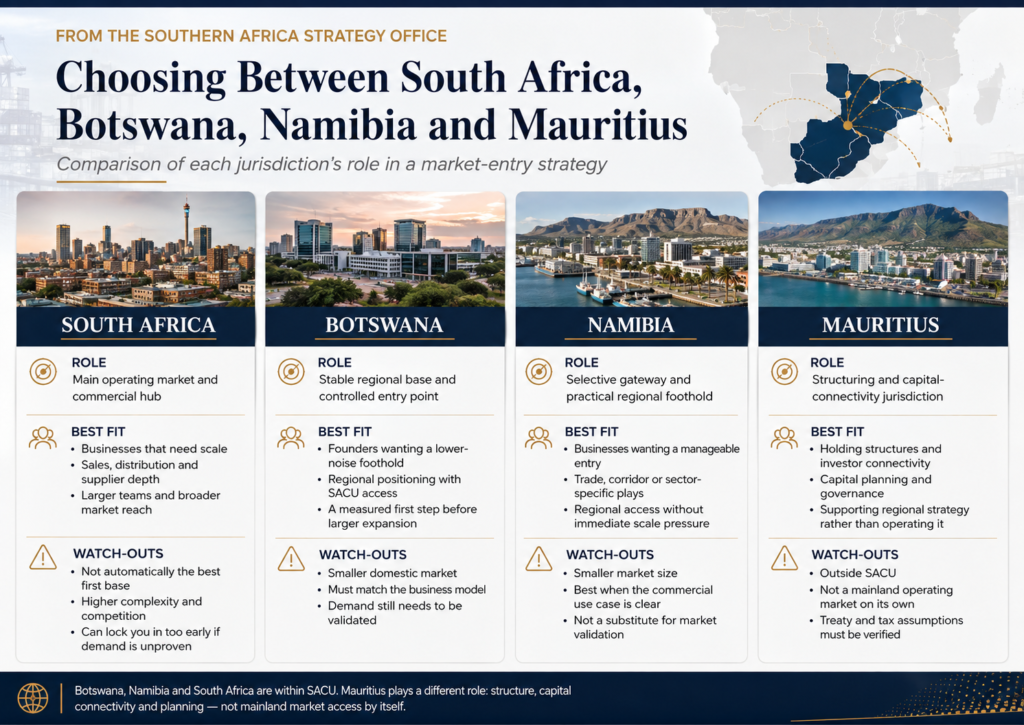
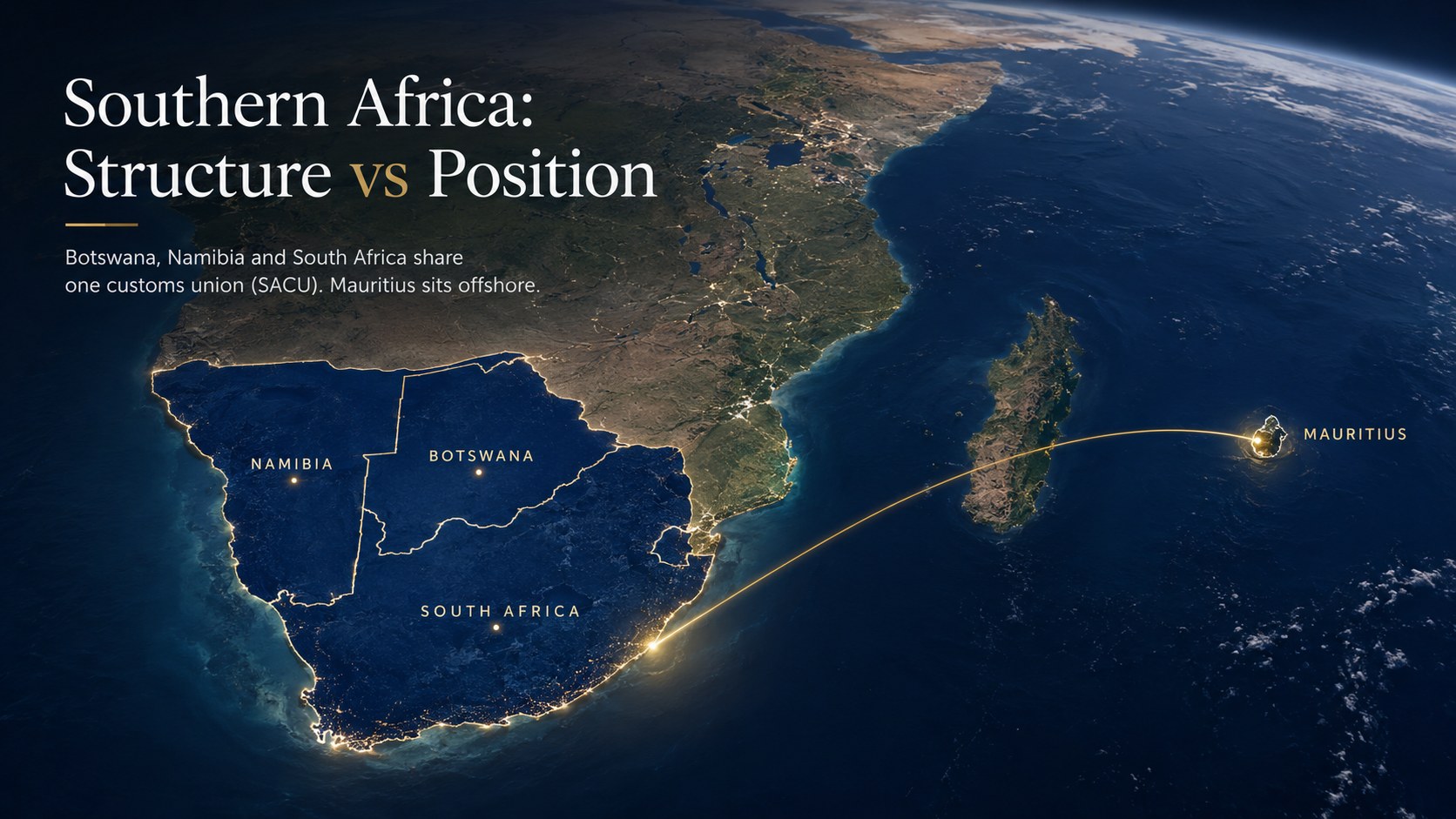
Botswana, Namibia and South Africa share the Southern African Customs Union and its common external tariff; Mauritius sits outside it. So Mauritius can structure your capital, but it does not, by itself, give you a market on the mainland. Its role is structure; the base countries provide position.
Treaty status changes: a 2024 protocol added a Principal Purpose Test to the India–Mauritius treaty; confirm the current position with India-side and Mauritius-side advisers.
Five wrong first moves in Southern Africa market entry
1.Choosing the country before validating the market. A jurisdiction is a container; demand is the content. Prove who buys, at what price, against whom — then let the market narrow the jurisdiction.
2.Treating South Africa as automatic. Ask two separate questions: which market do we sell into, and where should we be based to do it well? The answers are not always the same country.
3.Asking one jurisdiction to do every job. Mauritius structures; it does not operate. Let each place do what it is good at rather than forcing a single country to carry the whole plan.
4.Incorporating and moving capital before understanding the ground. These are the hardest moves to reverse. On the India side, outbound investment runs through the FEMA/RBI overseas-investment framework — take India-side advice before funds move. On the ground, treat banking-readiness and regulatory preparation as prerequisites. Note the word: readiness. No credible adviser can guarantee a bank account, an approval or a licence — only better odds and a cleaner timeline.
5.Choosing a local partner without a real test. Relationships matter here, which is exactly why the wrong partner is so costly: an unwound partnership can compromise the licence, the banking and the capital at once. Verify standing, understand incentives, and structure the relationship so exit stays possible before you become dependent.
A simple way to decide: Proceed / Pause / Pivot / Stop
Before committing capital, place your situation in one of four positions:
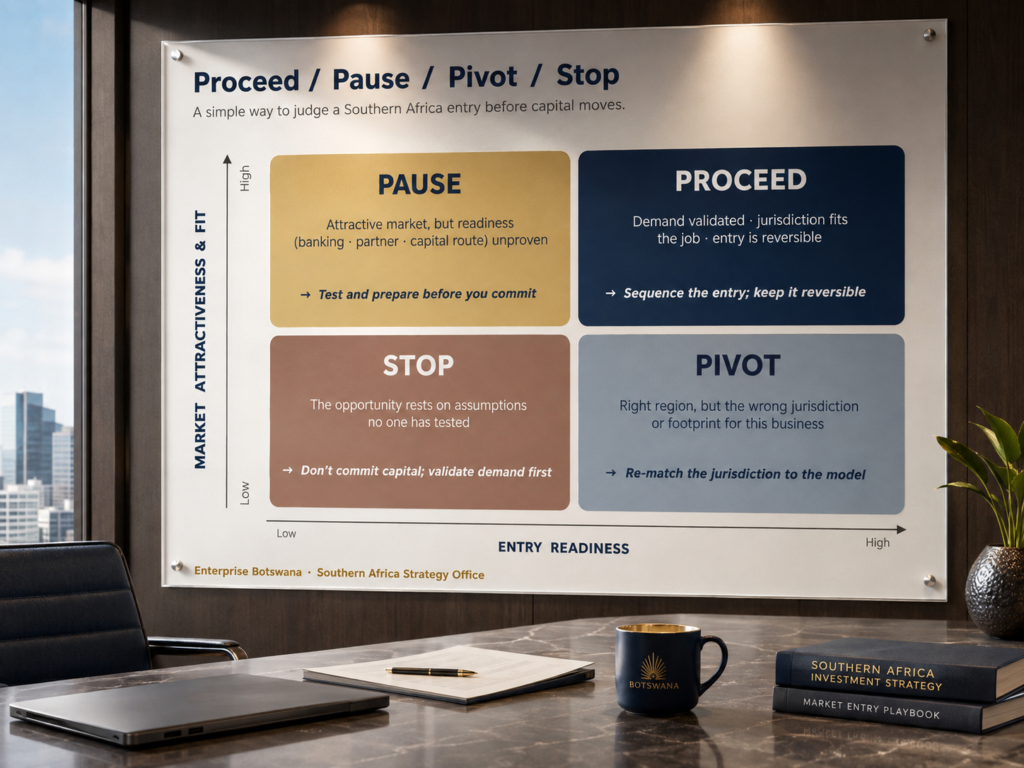
Most businesses that later regret an entry were at Pause or Stop and acted as if they were at Proceed.
What to verify before capital moves
- Demand: real buyers, real prices, a real route to them
- Jurisdiction fit: the base country matches the business model, not just the map
- India-side compliance: the FEMA/RBI/ODI path, handled by qualified India-side professionals, before funds move.
- Banking-readiness: pathways mapped — never assumed or “guaranteed.”
- Partner standing: verified, with an exit that survives a fall-out.
- Reversibility: what can be undone cheaply if an assumption proves wrong.
A measured next step
If you are weighing South Africa, Botswana, Namibia or Mauritius and want to test the decision before committing capital, the Wrong First Move Checklist lets you run the questions above yourself, in a few minutes, at no cost. If it shows you are ready to sequence, the Southern Africa Entry Risk Map provides a structured first assessment of jurisdiction fit, major risks and the questions to answer next.
→ Download the Wrong First Move Checklist
Frequently asked questions
Should an Indian SME enter South Africa first?
Not automatically. South Africa is the largest market, but the best first base depends on your business model; Botswana or Namibia can offer a more controlled entry with the same regional customs reach.
Is Mauritius enough on its own for a Southern Africa entry?
No. Mauritius is a structuring and capital-connectivity jurisdiction; it sits outside the SACU customs bloc and does not, by itself, give you an operating market on the mainland.
What is the biggest mistake to avoid?
Choosing a country — or incorporating and moving capital — before demand is validated. These early moves are the hardest to reverse.
How should capital move from India?
Through India’s FEMA/RBI overseas-investment (ODI) framework, planned with qualified India-side professionals before any funds move. Sequence and reporting matter.
Can you guarantee a bank account or licence?
No credible adviser can. The right goal is banking-readiness — preparing properly so the odds and the timeline improve.
Enterprise Botswana is the Southern Africa Strategy Office. We help Indian business owners and families make better decisions before they commit serious capital. We are jurisdiction-neutral at the diagnostic stage — the recommendation follows your commercial circumstances.