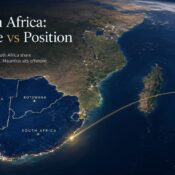


FROM THE SOUTHERN AFRICA STRATEGY OFFICE
Choosing where to enter Southern Africa is not a matter of picking the best country. A Southern Africa market entry decision is about matching a jurisdiction to the specific job your business needs it to do — and that is a decision you can make with method, not instinct.
Ask most Indian principals where they would enter Southern Africa, and the answer arrives quickly: South Africa. It is the largest economy, the most familiar name, the one with the visible brands and the diaspora and the direct flights. The reasoning feels self-evident — enter where the market is biggest.
But “biggest” is an answer to a question you may not be asking. The reflex to start in South Africa is really a shortcut past a decision that deserves a method. Because the honest truth is this: there is no best jurisdiction in Southern Africa. There is only the jurisdiction that best fits a particular business, with particular requirements, at a particular stage. This article is about how to find that fit — the actual method a principal can use to choose, rather than default.
Why “which country is best?” is the wrong question
A jurisdiction is not a single thing you can rank. It is a bundle of separate functions — a market to sell into, a base to operate from, a place to hold and move capital, a route for goods, a home for people. A country can be excellent at one of these and mediocre at another.
South Africa illustrates the point precisely. On market size and sophistication, it leads the region. On ease of entry, it is more demanding: it is competitive, its labour and regulatory framework is involved, and its broad-based black economic empowerment (B-BBEE) expectations shape ownership, procurement and partnering for foreign entrants in ways that need local advice to navigate. So is South Africa “best”? The question has no answer until you finish the sentence: best for what job, under which constraints, at what stage. Once you complete that sentence, the obvious entry point stops being obvious — and becomes one candidate among four.
Step one: define the job before you compare the countries
The mistake is to start with the countries. The discipline is to start with your own requirements. Before any comparison means anything, name what you actually need a jurisdiction to do for this business:
- Market access — are your buyers here, or reachable from here?
- Operating base — cost, speed and ease of running a company day to day.
- Structuring and capital — where holding, treaty access and capital connectivity sit.
- Logistics — ports, corridors and how goods actually move.
- People — talent, language, and any residency needs.
A packaging manufacturer selling to local retailers needs market access above all. An engineering-components exporter using the region as a springboard needs logistics and tariff access far more than local demand. A services firm needs banking and talent. These are different businesses, and they will rationally choose different countries. The jurisdiction question cannot be answered in the abstract — only against a defined job.
Step two: the criteria that actually drive the decision
Once the job is defined, the decision runs on a consistent set of criteria. These are the dimensions to weigh — the “how” of the choice:
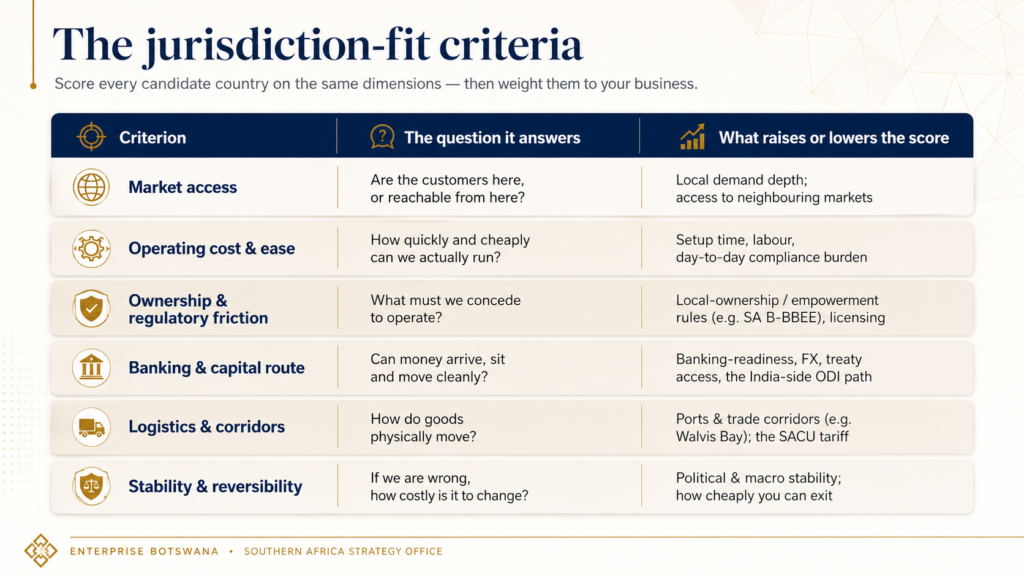
Notice what this list does: it turns an emotional decision (“South Africa feels right”) into a set of answerable questions. And notice that South Africa does not win every row — it tends to lead on market access and lose ground on ownership friction, while a smaller neighbour may reverse that pattern.
Step three: weight, score, and — crucially — sequence
The criteria above are universal; the weighting is not. This is where the method earns its keep.
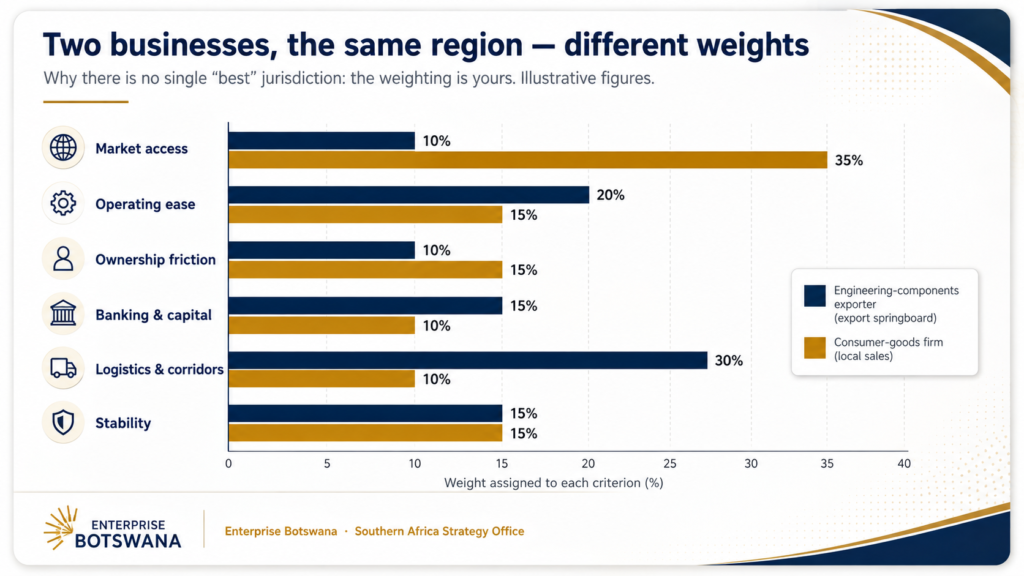
Weight the criteria to your business. The engineering-components exporter puts most of the weight on logistics, tariff access and operating ease, and very little on local market depth. The consumer-goods firm does the opposite. The weights are yours; they should reflect how your business actually makes money.
Score each candidate against each criterion. A simple, honest one-to-five will do. The point is not false precision — it is forcing yourself to compare the four jurisdictions on the same dimensions rather than on gut feel and reputation.
Then read the result as a sequence, not a single winner. This is the part principals miss. A good assessment rarely produces one country; it produces an ordered picture: this is our operating base, this is where structure might sit, this is a market we reach later, this one we can set aside. The output is a plan with an order, not a flag on a map.
To make it concrete — and this is illustrative, not a real client — consider a hypothetical Gujarat engineering-components firm using Southern Africa as an export springboard. Weighting logistics, tariff access and operating ease most heavily, its scorecard might favour a SACU base — where a common external tariff and a corridor to inland markets matter more than local retail demand — over a structuring hub like Mauritius, which would only enter the picture if a genuine holding or treaty need existed. Change the business to a firm chasing local consumer sales, and the same method could point straight back to South Africa despite its higher entry friction. Same region, same four countries, opposite answers — because the job was different.
If you do nothing else, start by naming your single heaviest-weighted criterion — the one thing this business cannot compromise on. That one answer already narrows the four jurisdictions. And a defined method gives you something a hunch never can: a decision you can put in front of the family, and defend.
As a rough orientation, the four jurisdictions tend to lead on different functions — South Africa on market depth, Botswana on a stable base, Namibia on logistics, Mauritius on structuring — as set out in our companion piece on the five wrong first moves . Treat those tendencies as hypotheses your own weighting must test, not conclusions to adopt.
What the scorecard cannot tell you
A scorecard is a decision aid, not a decision. It ranks options on paper; it cannot confirm that a bank will actually open the account, that a prospective partner is who they claim to be, or that a licence will issue on the timeline you assumed. Those are matters of readiness and verification, and they sit on the ground, not on the grid.
Two cautions keep the method honest. First, a scorecard is only as good as the demand assumption underneath it — if you have not validated that customers exist and will pay, the most careful weighting is only ranking assumptions. Second, the criteria that touch regulation, tax and capital movement are exactly the ones to verify with qualified professionals: South Africa’s empowerment and exchange-control rules with South-Africa-side advisers, and how capital leaves India — through the FEMA/RBI overseas-investment framework — with your India-side advisers, before any funds move. And a note on language that matters: no credible adviser deals in guaranteed banking. The right standard is banking-readiness — preparing so the odds and the timeline improve.
A measured next step
The method above is one you can run informally today. Applied rigorously to your specific business — your weighting, your four-country scoring, your sequence, and the risks each option carries — it becomes the Southern Africa Entry Risk Map: a structured first assessment of jurisdiction fit, the major risks, and the questions to answer before you commit capital, for US$199.
→ Request the Southern Africa Entry Risk Map
Frequently asked questions
Is South Africa the best place for an Indian SME to enter Southern Africa?
Not automatically. South Africa leads on market size but carries higher entry friction, including B-BBEE ownership and empowerment expectations. Whether it is right depends on how heavily your business weights local market access against cost, logistics and ease of entry.
How do I actually choose between South Africa, Botswana, Namibia and Mauritius?
Define the job first, then weight a consistent set of criteria — market access, operating ease, ownership friction, banking, logistics, stability — to your business, score each country on the same dimensions, and read the result as a sequence rather than a single winner.
Should my operating base and my holding structure be in the same country?
Often not. Operating position and capital structure are different jobs; a SACU base can provide market and logistics access while a structuring jurisdiction handles holding or treaty needs. Forcing one country to do both is a common source of cost.
How much should market size matter?
Only as much as your business depends on local demand. If you are using the region as an export or logistics springboard, market size should carry far less weight than tariff access and corridors.
Can a scorecard replace professional advice?
No. It structures the decision and shows you the trade-offs; it cannot confirm banking-readiness, partner quality or jurisdiction-specific legal and tax positions, which must be verified with appropriately qualified professionals.
Enterprise Botswana is the Southern Africa Strategy Office. We help Indian business owners and families make better decisions before they commit serious capital. We are jurisdiction-neutral at the diagnostic stage — the recommendation follows your commercial circumstances.