

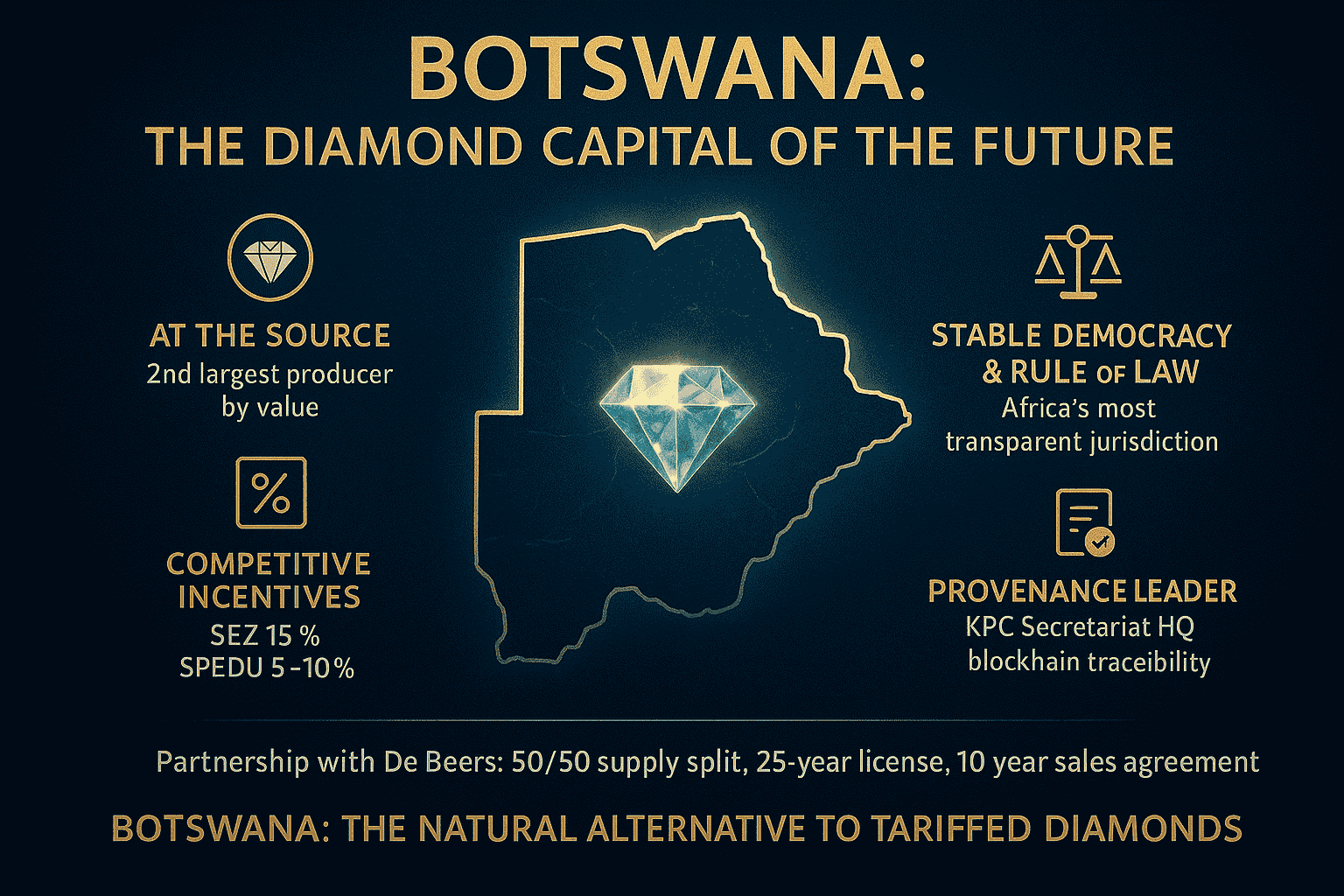
Botswana: The Natural Alternative to Tariffed Diamonds
Introduction: A Market in Structural Transition
In August 2025, the U.S. imposed tariffs of up to 50% on polished diamonds imported from India. The impact was immediate: export orders collapsed, factories in Surat idled, and margins were erased. India, which polishes 9 out of 10 diamonds sold globally, suddenly became the most expensive polishing hub in the world.
This is not a temporary trade dispute. It is a structural shock that is realigning supply chains, accelerating the rise of new hubs, and forcing diamantaires, traders, and investors to rethink their strategies.
One country stands out as the natural alternative: Botswana.
1. India’s Tariff Shock in Numbers
For decades, India’s model was simple and profitable: import rough, polish at scale, and export. That model has broken.
- 30–50% disadvantage: A polished diamond valued at $5,000 in Surat now enters the U.S. market with up to $2,500 in additional landed costs due to tariffs.
- Exports already falling: India’s polished exports to the U.S. dropped 23% year-on-year in August, according to customs filings.
- Factories idled: Industry associations report that as many as 40% of polishing units in Surat are inactive.
- Employment at risk: More than 250,000 jobs are threatened in the polishing sector.
For diamantaires, every quarter of delay in adapting erodes 12–18% of gross margins.
2. Why Origin Now Outperforms Transit
The diamond industry has long depended on transit hubs — Antwerp, Dubai, Surat — that processed and distributed stones. But tariffs, compliance demands, and consumer scrutiny are shifting the balance toward origin hubs.
- Cost efficiency: Polishing at the mine eliminates 2–3 layers of import/re-export, recovering 15–20% per carat.
- Traceability: Buyers in the U.S. and EU increasingly demand verifiable origin. Origin countries can certify supply directly.
- Policy alignment: Producer governments are incentivized to add value locally, offering a supportive regulatory environment.
The future will not be dominated by transit centers but by origin countries with credibility.
3. Botswana’s Quantifiable Advantages
a. Direct Rough Access = Margin Recovery
Polishing in Botswana cuts out import and re-export. On a $5,000 polished diamond:
- India (post-tariffs): $5,000 + $2,500 tariff = $7,500 landed cost.
- Botswana: $5,000 + $300–$500 additional local polishing costs = $5,300–$5,500 landed cost.
Net recovery per stone: ~$2,000. Multiply across volume and the advantage is decisive.
b. Stable and Transparent Governance
Botswana is not just another producer — it is often described as Africa’s most stable democracy. Since independence in 1966, it has maintained uninterrupted democratic rule, prudent fiscal management, and a transparent legal system.
- Rule of Law: Botswana consistently ranks among the top three African nations in the World Justice Project’s Rule of Law Index. Property rights are strong, contracts are enforceable, and courts are independent.
- Political Stability: Unlike many resource-rich states, Botswana has avoided the “resource curse.” Diamond revenues have been managed prudently, building fiscal reserves and financing infrastructure rather than fueling instability.
- Regulatory Predictability: The government has a reputation for honoring agreements and consulting openly with investors. This minimizes policy risk and makes Botswana one of the safest jurisdictions in the Global South.
For diamantaires and investors, this track record offers something rare in the resource trade: long-term certainty.
c. Partnership with De Beers: A Landmark Agreement
Botswana’s partnership with De Beers through Debswana accounts for roughly one-third of the world’s gem-quality diamond production by value.
In July 2023, Botswana and De Beers concluded a historic new agreement after tough but constructive negotiations:
- 50/50 Rough Split: Botswana can soon market upto 50% of Debswana’s production through its state-owned Okavango Diamond Company (ODC), up from 25%. This gives the government — and diamantaires dealing directly with ODC — far greater access to supply.
- 25-Year Mining License Extension: Guarantees continuity of mining until 2050.
- 10-Year Sales Agreement: Ensures long-term stability for buyers sourcing rough through both ODC and De Beers.
- Local Beneficiation: De Beers committed to expand cutting, polishing, sorting, and training operations inside Botswana, boosting the skills base and domestic value-add.
For diamantaires, this agreement is pivotal: it ensures a secure, diversified supply pipeline anchored in one of the world’s most reliable jurisdictions.
d. Provenance, Reputation, and the Kimberley Process
In today’s diamond trade, provenance is as important as price. Buyers in the U.S. and EU demand verifiable origin, while regulators enforce strict compliance.
Botswana delivers unmatched credibility:
- Conflict-Free Reputation: Botswana’s diamonds are universally recognized as responsibly sourced.
- Kimberley Process Leadership: In 2024, the Kimberley Process Certification (KPC) Permanent Secretariat was relocated to Gaborone, Botswana, cementing the country as a global hub for diamond compliance. This means the world’s main regulatory office for preventing conflict diamonds now sits in the same country as the mines.
- Advanced Traceability: Botswana is piloting blockchain and digital certification to provide mine-to-market tracking.
- Market Premium: U.S. and European retailers report that diamonds of Botswana origin often command a reputational premium, because provenance is as much a sales driver as brilliance.
For diamantaires, relocating to Botswana provides not only cost recovery but a compliance shield. Saying “these stones come from Botswana” satisfies regulators, reassures buyers, and protects brand reputation.
e. Competitive Tax & SEZ/SPEDU Incentives
- Corporate tax: 22% standard rate.
- Special Economic Zones (SEZs): offer rates as low as 15%, plus duty exemptions, fast-track licensing, and infrastructure tailored for manufacturing and processing.
- SPEDU Zone (Selebi-Phikwe): provides even deeper incentives, with reduced tax rates of 5–10% for the first 5 years, provided companies reinvest and employ locally.
These regimes make Botswana not just competitive, but in some cases cheaper than India even before tariffs.
f. Workforce and Training
Botswana’s polishing workforce is smaller than India’s, but growing rapidly. With De Beers’ commitment to local beneficiation and government-backed training programs, new entrants can secure skilled labor at competitive wages and help shape the long-term labor pool.
g. Strategic Location
Botswana’s location in Southern Africa allows it to serve not just its own mines but potentially those of neighboring producers such as Angola and Namibia. As infrastructure expands, Botswana is positioned to become the diamond capital of the region.
4. Comparative Landscape
| Factor | India (post-tariffs) | Dubai | Mexico | Botswana |
| Supply access | Imported rough | Imported rough | Imported rough | At source |
| Tariff exposure | 30–50% disadvantage | None | None | None |
| Cost per carat | +$2,500 (tariff) | +$600–800 (import + logistics) | Unclear | –$2,000 advantage |
| Governance | Stable but exposed | Stable | Unpredictable | Transparent democracy |
| Provenance trust | Questioned | Increasing scrutiny | Weak | High credibility (KPC HQ in Gaborone) |
| Ecosystem maturity | Established | Mature transit hub | Nascent | Rapidly developing |
| Tax environment | 25%+ effective | 0% personal tax, but import costs | Uncertain | 15–22% corporate (5–10% in SPEDU) |
5. Case Studies: Botswana in Action
Enterprise Botswana and its partners have already executed cross-border projects demonstrating speed and credibility:
- Aerospace consortium: Operationalised in 45 days, enabling operations.
- Global mining investor: Secured contracts with Botswana operators, diversifying into African resources.
- European bank: Advised on setting up local offices, enabling structured trade finance.
- Diamond buyer: Introduced into Southern Africa, securing $200m in long-term rough supply contracts.
These outcomes prove Botswana is not theory — it is execution in practice.
6. Risks and Mitigation
A balanced perspective requires recognizing challenges:
- Skills gap: Workforce still developing.
- Mitigation: Training partnerships and De Beers’ beneficiation commitments.
- Infrastructure constraints: Limited capacity in Gaborone.
- Mitigation: SEZ/industrial zones expanding with tax incentives.
- Dependence on De Beers allocations: Shifts possible.
- Mitigation: 2023 agreement guarantees upto 50% supply through ODC and 25-year mining license stability.
7. Investor and Capital Opportunities
Botswana’s rise is not only a relocation story. It is an investment story:
- Private equity: Backing new cutting centers in SEZs.
- Banks: Relocating trade finance operations closer to deals.
- Sovereign funds: Co-investing in SPEDU infrastructure.
- Fintech: Building digital escrow and traceability solutions for compliance-driven markets.
With KPC offices in Gaborone and SEZ/SPEDU incentives in place, Botswana is poised to attract not just diamantaires but global capital.
8. Enterprise Botswana: The Bridge
Relocation is complex. Enterprise Botswana provides a one-stop entry point:
- Fast-track licensing: 45–60 days.
- Banking and escrow: Structured settlement services via Khan & Khan Law Offices.
- Local partnerships: Supplier, logistics, property, workforce connections.
- Compliance advisory: Legal, tax, and labor frameworks.
- SEZ/SPEDU navigation: Tailored support to secure preferential tax regimes.
Conclusion: The Natural Alternative
The U.S. tariffs on Indian polished diamonds are not a passing storm — they are a permanent shift. Transit hubs that add cost without provenance credibility are no longer sustainable.
Botswana, with its direct supply, stable governance, De Beers partnership, KPC Secretariat, and SEZ/SPEDU tax incentives, is not just an alternative. It is the natural choice for diamantaires, traders, and investors who want to protect margins, meet compliance demands, and position for long-term growth.
Enterprise Botswana stands ready to guide diamantaires and investors into Botswana’s next chapter. Contact us today for a confidential consultation.

Recent Posts