

India’s Historic Visit to Botswana: A New Chapter in Diamond Diplomacy and Strategic Partnership
Introduction: When Two Democracies Unite
Picture this: A historic moment unfolding in the heart of Southern Africa, where the world’s largest democracy meets one of Africa’s most stable democracies. On November 12, 2025, President Droupadi Murmu of India touched down in Gaborone, Botswana, marking a watershed moment in Indo-African relations. This wasn’t just another diplomatic visit—it was the first-ever state visit by an Indian head of state to Botswana in 59 years of diplomatic relations.
As the 21-gun salute echoed across Sir Seretse Khama International Airport, it symbolized more than just protocol. It represented the convergence of two nations bound by shared democratic values, mutual respect, and a glittering connection: diamonds.
In this article, we’ll explore how President Murmu’s three-day visit to Botswana is reshaping bilateral relations, why the Diamond Trading Company Botswana (DTCB) visit matters to India’s economy, and what this historic partnership means for both nations’ futures.
The Significance of President Murmu’s Botswana Visit
A 59-Year Wait Ends
This marks India’s first Head-of-State visit to Botswana in 59 years of diplomatic relations, making it a momentous occasion for both countries. The visit also represents the first state visit hosted by Botswana since President Duma Gideon Boko assumed office, adding another layer of historical significance.
Why now? The timing couldn’t be more strategic. As 2026 approaches, both nations will commemorate 60 years of diplomatic relations, providing the perfect foundation for renewed collaboration and expanded partnerships.
From Angola to Botswana: A Strategic African Tour
President Murmu’s Botswana visit forms the second leg of her historic two-nation African tour. Coming from Angola, where India commemorated 40 years of diplomatic relations, the President’s African journey underscores New Delhi’s deepening commitment to the continent.
During their talks, both leaders agreed to expand cooperation in key areas, including trade and investment, agriculture, renewable energy, health, education, skill development, defence, and digital technology. This comprehensive approach signals India’s long-term vision for Africa—one that goes beyond transactional relationships to build meaningful, multifaceted partnerships.
Inside the Diamond Trading Company Botswana (DTCB) Visit
Understanding DTCB’s Global Importance
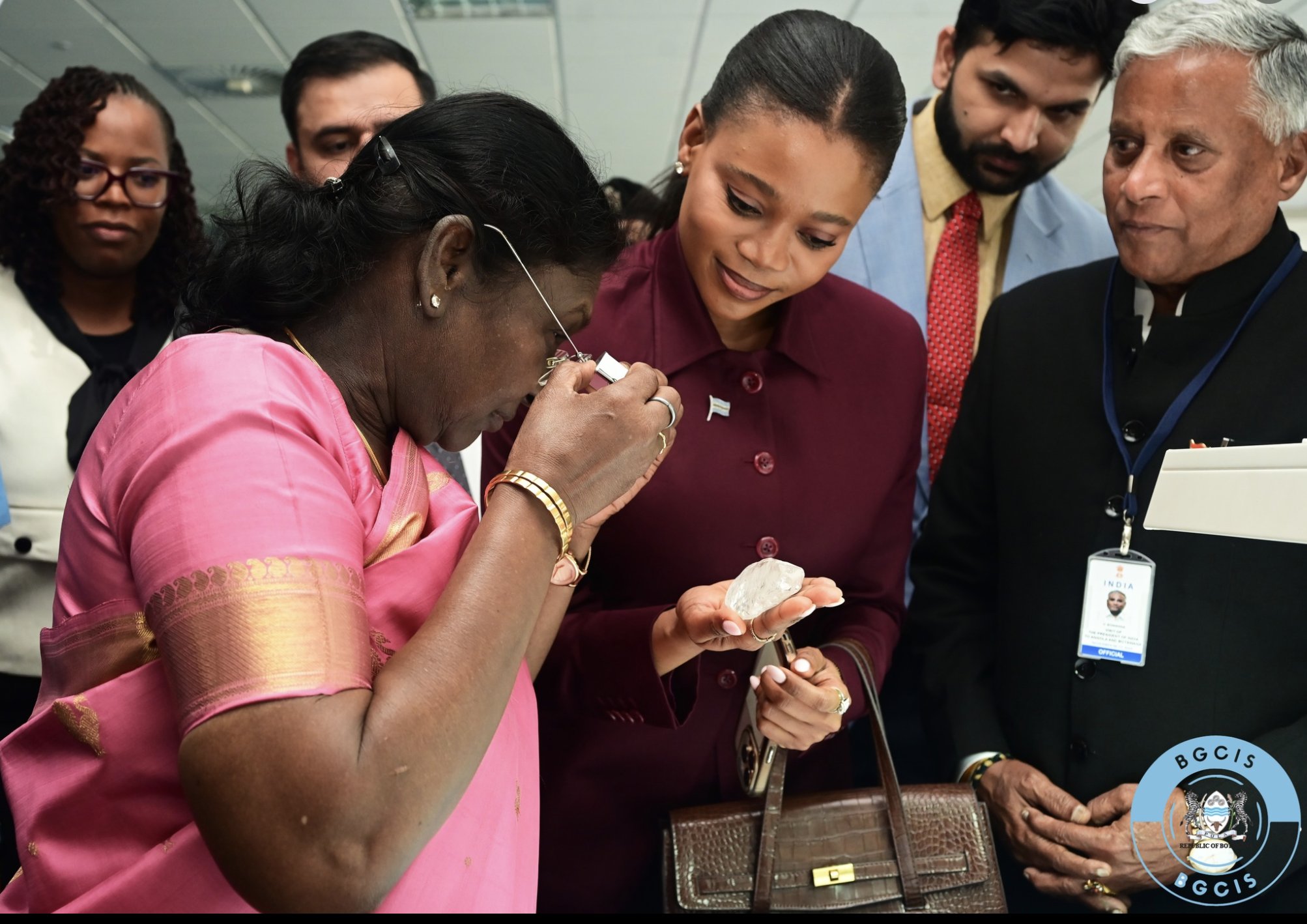
The highlight of President Murmu’s itinerary was her visit to the Diamond Trading Company Botswana (DTCB), and for good reason. DTCB is a 50/50 Joint Venture partnership between the Government of the Republic of Botswana and De Beers Group, operating the world’s largest and most sophisticated rough diamond sorting and valuing operation, with a capacity to sort 45 million carats a year.
Think about that for a moment: 45 million carats annually. That’s not just impressive—it’s transformative for both Botswana’s economy and India’s thriving diamond industry.
Why India’s DTCB Visit Matters
During her visit to DTCB, President Murmu was received by Botswana’s Minister of Minerals and Energy, Bogolo Kenewendo, and was briefed about the importance of the diamond sector in Botswana’s economy, receiving a guided tour of the rough diamond sorting and valuing operations.
Here’s where it gets interesting for India: Botswana is the world’s leading producer of rough diamonds by value and the second-largest by volume. India remains one of Botswana’s biggest diamond buyers, creating a natural synergy between Botswana’s production prowess and India’s diamond processing expertise.
The India-Botswana Diamond Connection
The diamond trade forms the backbone of bilateral commerce between these nations. Botswana exports rough diamonds to India, where they’re transformed into polished gems that capture hearts worldwide. In return, India supplies Botswana with pharmaceuticals, machinery, iron and steel, and electrical equipment.
India had a USD 506 million worth of trade with Botswana during the 2024-25 fiscal, with diamonds dominating this exchange. This symbiotic relationship showcases how two nations can leverage their respective strengths for mutual prosperity.
Key Outcomes and Agreements from the Visit
Bilateral Talks: Building Bridges Across Sectors
President Murmu’s discussions with President Duma Gideon Boko were comprehensive and forward-looking. The leaders explored opportunities to deepen cooperation across multiple sectors:
Trade and Investment: Expanding business partnerships and creating new avenues for bilateral commerce
Health and Pharmaceuticals: The leaders witnessed the signing of an agreement on pharmacopoeia, enabling access to affordable, high-quality Indian medicines in Botswana, with India also announcing the supply of essential ARV medicines at Botswana’s request
Agriculture and Food Security: Sharing best practices and technologies to enhance agricultural productivity
Renewable Energy: Collaborating on sustainable energy solutions aligned with both nations’ climate commitments
Education and Skill Development: In the last decade alone, more than a thousand young people from Botswana have studied and trained in India, returning home with new skills, expanded knowledge and lasting friendships
Digital Technology: Exploring partnerships in digital infrastructure and innovation
Defence Cooperation: Strengthening security ties and sharing strategic insights
A Rare Gift: Eight Cheetahs for Project Cheetah
One of the most touching aspects of President Murmu’s visit was the wildlife conservation initiative. Botswana’s decision to assist India in the next phase of ‘Project Cheetah’ involves transferring eight Kalahari desert cheetahs to India, which were released into a quarantine facility at the Mokolodi nature reserve.
This isn’t just about animals—it’s about shared environmental stewardship. Project Cheetah aims to restore cheetahs to India’s ecosystems, and Botswana’s support demonstrates the depth of bilateral trust and cooperation.
President Murmu Addresses Botswana’s National Assembly
Democracy Recognizes Democracy
In a powerful moment of diplomatic exchange, Botswana President Advocate Duma Gideon Boko hailed India as the “mother of democracy” and praised New Delhi’s role as a steadfast partner in Botswana’s development journey.
President Murmu’s address to the National Assembly was equally significant. She highlighted how both nations, despite differing socio-economic conditions, share fundamental democratic values that serve as the foundation for their partnership.
Connecting Two Visions: Viksit Bharat and Agenda 2063
President Murmu emphasized that India’s vision of “Viksit Bharat” (Developed India) by 2047 and Africa’s ‘Agenda 2063’ present an opportunity for active collaboration between the two countries. She underscored that collaboration between India and African countries can help unlock the energies of their combined 2.8 billion people, who comprise 40 percent of the world’s population.
This long-term vision transforms bilateral relations from mere diplomatic courtesy to a shared journey toward prosperity and development.
Cultural Diplomacy: Beyond Politics and Economics
Honoring Botswana’s Heritage
President Murmu’s visit wasn’t confined to boardrooms and parliaments. She visited the Three Dikgosi Monument at Gaborone and paid respects before the statues of three Dikgosi (tribal chiefs)—Khama III of the Bangwato, Sebele I of the Bakwena, and Bathoen I of the Bangwaketse, who played important roles in Botswana’s independence movement.
These gestures matter. They show respect for Botswana’s history, culture, and the struggles that shaped its democracy. In diplomacy, such symbolic acts often speak louder than signed agreements.
Meeting the Indian Diaspora
Another crucial component of the visit was President Murmu’s engagement with the Indian community in Botswana. This diaspora serves as a living bridge between the two nations, contributing to Botswana’s economy while maintaining cultural ties with India.
President Murmu emphasized that “the friendship between India and Botswana is not just between the governments. It is a friendship between peoples who respect each other and share the same hopes for a peaceful and prosperous future”.
India’s Broader Africa Strategy: Context and Implications
Why Africa Matters to India
President Murmu’s visit to Botswana and Angola reflects India’s strategic pivot toward Africa. Africa’s vast reserves of natural resources are crucial for meeting India’s growing energy and industrial demands, while the continent’s proximity to the Indian Ocean holds strategic importance for India’s maritime and security interests.
But India’s approach differs from traditional great power engagement with Africa. Rather than extractive relationships, India emphasizes:
- Capacity Building: Training African professionals in Indian institutions
- Technology Transfer: Sharing expertise without strings attached
- South-South Cooperation: Collaboration among developing nations
- Respect for Sovereignty: Partnership based on mutual respect
Economic Opportunities in Southern Africa
Botswana represents more than just diamonds for India. Indian firms are active in Botswana’s diamond, energy, and infrastructure sectors, creating employment and contributing to local economies.
The relationship exemplifies win-win cooperation: Botswana gains access to Indian expertise, technology, and markets, while India secures reliable partnerships in strategic resources and expands its diplomatic footprint.
The Diamond Trade: A Glittering Foundation
Understanding the Value Chain
Here’s what makes the India-Botswana diamond partnership fascinating:
Botswana’s Role: Mining and sorting world-class rough diamonds India’s Expertise: Processing, cutting, and polishing these gems Global Market: Supplying finished diamonds to consumers worldwide
The Diamond Trading Company sells diamonds sourced from De Beers’ mining operations, with operations in South Africa, Botswana, and Namibia, sorting these diamonds into approximately 12,000 different categories based on size, shape, quality and color.
India processes approximately 90% of the world’s diamonds by volume, making it the global hub for diamond manufacturing. The raw material from Botswana undergoes transformation in Indian workshops, where skilled artisans bring out their brilliance.
Economic Impact
The diamond trade creates thousands of jobs in both countries:
- In Botswana: Mining, sorting, and preliminary processing
- In India: Cutting, polishing, jewelry manufacturing, and export
This value chain demonstrates how international trade, when structured equitably, can benefit all parties involved.
Challenges and Opportunities Ahead
Navigating Global Economic Headwinds
While the visit celebrates achievements, both nations face shared challenges:
Diamond Market Volatility: Global economic uncertainties affect luxury goods demand Sustainability Concerns: Ensuring mining practices meet environmental standards Competition: Other nations seeking to capture value from the diamond trade Technological Disruption: Lab-grown diamonds changing market dynamics
Opportunities for Growth
However, opportunities abound:
Downstream Industries: Developing diamond jewelry manufacturing in Botswana Technology Partnerships: Collaborating on mining technology and sustainability Diversification: Expanding cooperation beyond diamonds into other sectors Youth Engagement: Training the next generation of professionals
President Murmu highlighted that the youth of today need not just education and skilling, but also avenues to build their professional lives and channelize creative energies towards nation-building efforts.
What This Means for Global South Cooperation
A Model for South-South Partnerships
President Murmu’s visit reaffirms India’s position as a reliable partner in Africa’s development journey, reflecting a shared vision for economic growth, regional stability, and a balanced, multipolar world order led by emerging economies of the Global South.
This partnership offers lessons for other developing nations:
- Mutual Respect: Partnerships based on equality, not dependency
- Long-term Vision: Building relationships that span generations
- Comprehensive Engagement: Looking beyond single sectors to holistic cooperation
- Cultural Sensitivity: Respecting each nation’s unique history and values
Countering Neo-Colonial Patterns
In an era where some powers engage with Africa primarily for resource extraction, the India-Botswana partnership offers an alternative model—one where African nations maintain sovereignty, develop local capacity, and share equitably in economic benefits.
Looking Forward: The Road to 2026 and Beyond
Commemorating 60 Years
As both nations approach their 60th anniversary of diplomatic relations in 2026, expectations are high. The groundwork laid during President Murmu’s visit will shape bilateral relations for decades to come.
Key areas to watch:
Implementation: How quickly will the signed agreements be operationalized? Expansion: Will other Indian states and Botswana regions develop sister relationships? Innovation: What new sectors will emerge as collaboration points? Youth Exchange: How will educational partnerships evolve?
From Vision to Reality
President Murmu urged all to work together to build a partnership that enriches both nations and contributes to the greater good of the world. This aspiration captures the spirit of the visit—not just bilateral gains, but contribution to global prosperity.
Conclusion: Diamonds, Democracy, and Shared Destiny
President Droupadi Murmu’s historic visit to Botswana represents more than diplomatic protocol or trade negotiations. It symbolizes the convergence of two democratic nations committed to shared prosperity, mutual respect, and collaborative development.
From the sophisticated operations at the Diamond Trading Company Botswana to the solemn tribute at the Three Dikgosi Monument, from bilateral talks at the highest level to engagement with the diaspora community—every element of this visit reinforced a simple truth: meaningful partnerships are built on understanding, respect, and shared vision.
As India works toward its “Viksit Bharat” vision by 2047 and Botswana pursues its development goals aligned with Africa’s Agenda 2063, the strengthened ties forged during this historic visit will serve both nations well.
The diamonds that flow from Gaborone to Mumbai and back to the world market are more than commodities—they’re symbols of a partnership that transforms raw potential into polished excellence, much like these two nations are doing with their bilateral relationship.
Your Turn to Engage
What aspects of the India-Botswana partnership interest you most? Do you see opportunities for your business or community to engage with these growing ties? Share your thoughts in the comments below, and don’t forget to subscribe to stay updated on developments in India-Africa relations.
Have insights on the diamond trade or bilateral relations? We’d love to hear from you. Share this article with your network and join the conversation about how developing nations can build mutually beneficial partnerships.

Recent Posts


Botswana: The Duty-Free Diamond Destination for Indian Businesses